Showing posts with label Passover. Show all posts

Sunday, April 4, 2010

Was the Passover Lamb Slaughtered at the Temple Before the Crucifixion of the Messiah?

Dr. Fruchtenbaum is a wonderful Bible teacher, so edifying and ALWAYS Bible-based!
_____________________


Was the Passover Lamb Slaughtered at the Temple Before the Crucifixion of the Messiah?

Arnold FruchtenbaumBy Arnold Fruchtenbaum
Ariel Ministries

Q. Was the Passover lamb slaughtered at the Temple before the crucifixion of the Messiah took place?

A. The answer to this question is both yes and no. It should be kept in mind that there is a distinction between the first night of Passover and the first day of Passover. It is on the first night of Passover that all of the Jewish families eat the Passover meal, and Yeshua (Jesus) ate His last Passover meal on the first night of Passover. That is when He inaugurated the communion service. The next morning was the first day of Passover and at nine o'clock in the morning there was a special Passover sacrifice of which only the priesthood could eat. Yeshua was nailed to the cross on the first day of Passover at nine o'clock in the morning, which was the same time that the special Passover sacrifice was being offered up.

In the biblical practice, the lamb that was to be killed for the Passover was set aside on the tenth of the month of Nisan. It was then tested from the tenth day until the fourteenth day of that month to make sure that it was without spot and without blemish. On the fourteenth day the lamb was killed for the Passover meal. The next morning there was another lamb that was used as the Passover sacrifice for the nation of Israel. According to Exodus 12:46, the offering was slaughtered in a way that no bone of this lamb was to be broken.

Yeshua set Himself aside as the Passover Lamb. It occurred on the tenth day of the month, the same day that the physical animal was set aside. From the tenth day until the fourteenth day of the month, Yeshua was tested by the Pharisees, by the Sadducees, by the Scribes, and by the Herodians. By answering all of their objections and questions, He showed that He was without spot and without blemish. Yeshua ate the Seder meal on the first night of the Passover, the same night that all the Jewish people ate it, the fourteenth of Nisan. Yeshua died on the first day of Passover. He was crucified at nine o'clock in the morning and it was at nine o'clock in themorning that the special Passover sacrifice was offered in the Temple compound. Just as the Jews were very careful to make sure that not a single bone of the Passover lamb was broken, John 19:36 points out that not a single bone of Yeshua was broken either - not during the course of the crucifixion itself, nor by the Roman soldiers at the end of it all.

Friday, October 5, 2007

Seven Feasts of Israel....And How they Prophecied the The 1st and 2nd Coming of Jesus Christ

http://www.inplainsite.org/html/seven_feasts_of_israel.html
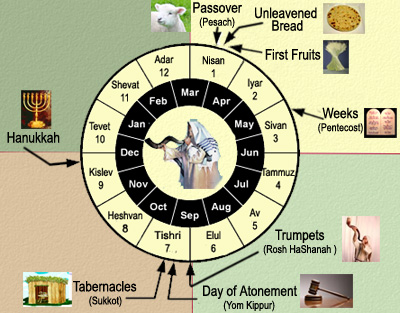
has a wonderful explanation for Christians of the 7 feasts of Israel - how they relate to Jesus's first coming as well as his second coming. Including this wonderful chart showing exactly where it all falls within our own western calendar.
Introduction Notice that the feasts fall into three clusters. The first three feasts Passover, Unleavened Bread, and First Fruits occur in rapid succession in the spring of the year over a period of eight days. They came to be referred to collectively as "Passover."

The fourth feast, Harvest, occurs fifty days later at the beginning of the summer. By New Testament times this feast had come to be known by its Greek name, Pentecost, a word meaning fifty.

The last three feasts Trumpets, Atonement, and Tabernacles extend over a period of twenty-one days in the fall of the year. They came to be known collectively as "Tabernacles." (The Feasts of Israel A Study in Symbolic Prophecy by Dr. David R. Reagan)

Go to http://www.inplainsite.org/html/seven_feasts_of_israel.html to read on........

It is important for a Christian to understand the prophetic implications of the Feasts of Israel. You will understand better the New Testament by understanding hos the feasts are also prophetic. Once you understand these, you will better see the timing of prophetic events and the ORDER in which they will happen......perhaps even the actual days in which they will happen......however, the year itself is unknown as Jesus told us in Matthew 24:36 "But of that day and hour no one knows, not even the angels of heaven, nor the Son, but the Father alone."


Sunday, April 15, 2007

Christian: Do You Celebrate EASTER or PASSOVER?

"Easter is the time when Christians commemorate the death of Jesus Christ, and celebrate his Resurrection. From a series of fraudulent trials, to a willing self-sacrifice that redeemed the whole of creation, Resurrection Day is full of meaning and significance." (source: http://www.khouse.org/topical_bible_study/easter/) - but do you know many of those traditions are pagan in origin? By no means does it mean we should not celebrate the sacrifice, death and resurrection of our Messiah, but rather that we should instead attempt to learn how He celebrated His last meal, the Pesech (Passover) meal the night before He was led to slaughter for our sins (yours and mine).

Testimony of a Christian's first Messianic Jewish Passover meal from www.ariel.org:
"A NON-JEWISH BELIEVER CELEBRATES PASSOVER
by R.C. Burris
(source: http://www.ariel.org/nps07spring.htm)

My first introduction to the Messianic Jewish Movement and the formation of new, lifelong friendships with Messianic Jewish believers was my first Passover seder at a local San Antonio Messianic congregation.

Over the years I have come to understand that traditional Christians tend to understand the Passover celebration only in terms of Communion and the Last Supper, while Jewish people understand Passover in terms of the traditional retelling of the Exodus story at a specially prepared meal called a seder. By celebrating the feast within the setting of Jewish believers, I have combined the traditional Christian and Jewish elements of the Passover to reach a deeper understanding of the Passover’s fulfillment in Jesus (Yeshua).

Since the first Passover in the land of Egypt, God has commanded the Feast to be celebrated annually. It is a time for all Jewish people to recall the great work the covenant-keeping God of Israel did to redeem them out of their bondage in the land of Egypt. In addition, Passover celebrations provide all believers in Messiah an opportunity to reflect on the greater Messianic significance spoken of in Isaiah 53 and fulfilled in Yeshua (Jesus) — the spotless Lamb of God (John 1:29) — our Passover sacrifice (1 Corinthians 5:7).

Like the unleavened bread (matzah) of Passover, Yeshua was without sin. And like the matzah bread, He was also striped (Isaiah 53:5) and pierced (Zechariah 12:10). The broken bread represents His broken body: His willing sacrifice and death on the cross. And like the afikomen (the matzah hidden then retrieved after the Passover meal), He was wrapped in linen and hidden away. The shed blood of Yeshua is also pictured in the Passover by the third cup of the meal, the Cup of Redemption. Just as the blood of the Passover lamb was to be applied to the doorposts of each home, we too must apply the shed blood of Yeshua, the Lamb of God, to the doorposts of our heart. Bread and wine are also the elements of communion that are symbols of God’s New Covenant (Jeremiah 31:31-34), the covenant of Grace for everyone, whether Jewish in heritage or not.

If in the future you are interested in celebrating Passover Messianic-style with your family, Ariel Ministries offers an illustrated Haggadah, which participants can use to lead them step-by-step through the ceremony. It gives a brief overview of the Passover celebration and basic instructions for how to prepare, including some traditional Jewish recipes.

Another resource from Ariel Ministries is The Unleavened Messiah - A Portrait of Christ in the Passover, a DVD that can be played during the seder meal to guide the Passover celebration. Steven Ger, who leads the celebration, is a Jewish believer. In his presentation, he bridges the cultural gap between modern Christianity and first-century Judaism. "